
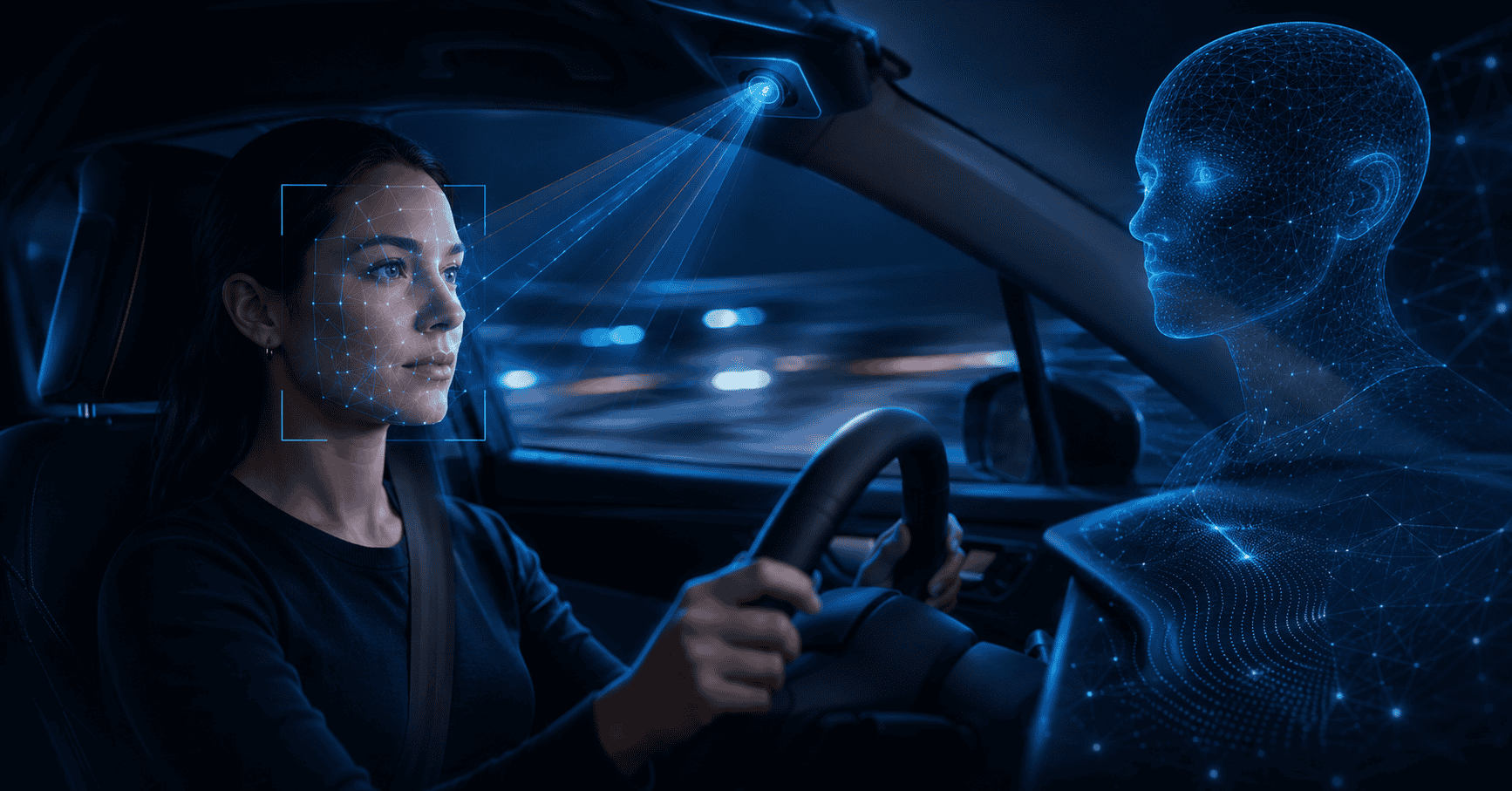
dSPACE is expanding the capabilities of its Aurelion software platform with a new solution designed to support the development and testing of driver monitoring systems (DMS). The enhancement brings more detailed simulation of both the vehicle occupant and the infrared cameras commonly used in modern driver monitoring applications.
Driver monitoring has become an increasingly important part of vehicle safety as automakers work to meet stricter regulatory and consumer expectations. Requirements from organizations such as Euro NCAP, along with the European Union’s General Safety Regulation (GSR), are placing greater emphasis on technologies capable of assessing driver attention, alertness, and behavior.
Testing these systems with real drivers, however, can be challenging. Drivers differ considerably in appearance, behavior, posture, and responses, while the number of possible situations that a monitoring system may encounter on the road is enormous. Trying to cover every combination with physical testing and human participants can therefore be time-consuming, expensive, and difficult to reproduce.
Aurelion’s new driver monitoring capabilities address these challenges through simulation. The platform combines detailed, animated 3D driver models with physics-based simulation of infrared cameras, allowing engineers to recreate sensor data in a controlled virtual environment.
This approach makes it possible to evaluate DMS functions across a broad range of conditions. Engineers can examine scenarios involving different driver characteristics, seating positions, camera configurations, lighting environments, and driving situations. The system can also represent various near-infrared sensor technologies, helping developers test how their algorithms perform under changing conditions.
One of the key benefits of simulation is repeatability. The same scenario can be recreated as many times as required, allowing engineers to identify performance differences, investigate edge cases, and validate algorithm updates without relying on repeated physical tests. It also allows unusual or difficult-to-reproduce situations to be introduced safely during development.
The new functionality is integrated into the wider dSPACE toolchain, providing support throughout the development process. Engineers can create scenarios, generate simulated sensor information, and use the resulting data for ECU testing and validation. The solution supports both software-in-the-loop (SIL) and hardware-in-the-loop (HIL) environments, enabling teams to move from early algorithm development toward more advanced validation within a connected workflow.
Another important feature is the ability to combine simulated sensor outputs with restbus signals and ground-truth data. This gives developers a more complete view of system behavior and can help them assess whether DMS algorithms correctly interpret a driver’s state.
According to dSPACE, early practical use has demonstrated that simulated infrared imagery can be supplied to commercial driver monitoring algorithms and successfully processed by them. This indicates that virtual sensor environments can play a meaningful role in testing real-world DMS technology.
With Aurelion driver monitoring, dSPACE is aiming to make DMS development more automated, repeatable, and scalable. As driver monitoring becomes increasingly central to vehicle safety, simulation-based validation could help manufacturers and suppliers test a much wider range of conditions while reducing their dependence on traditional physical testing.