
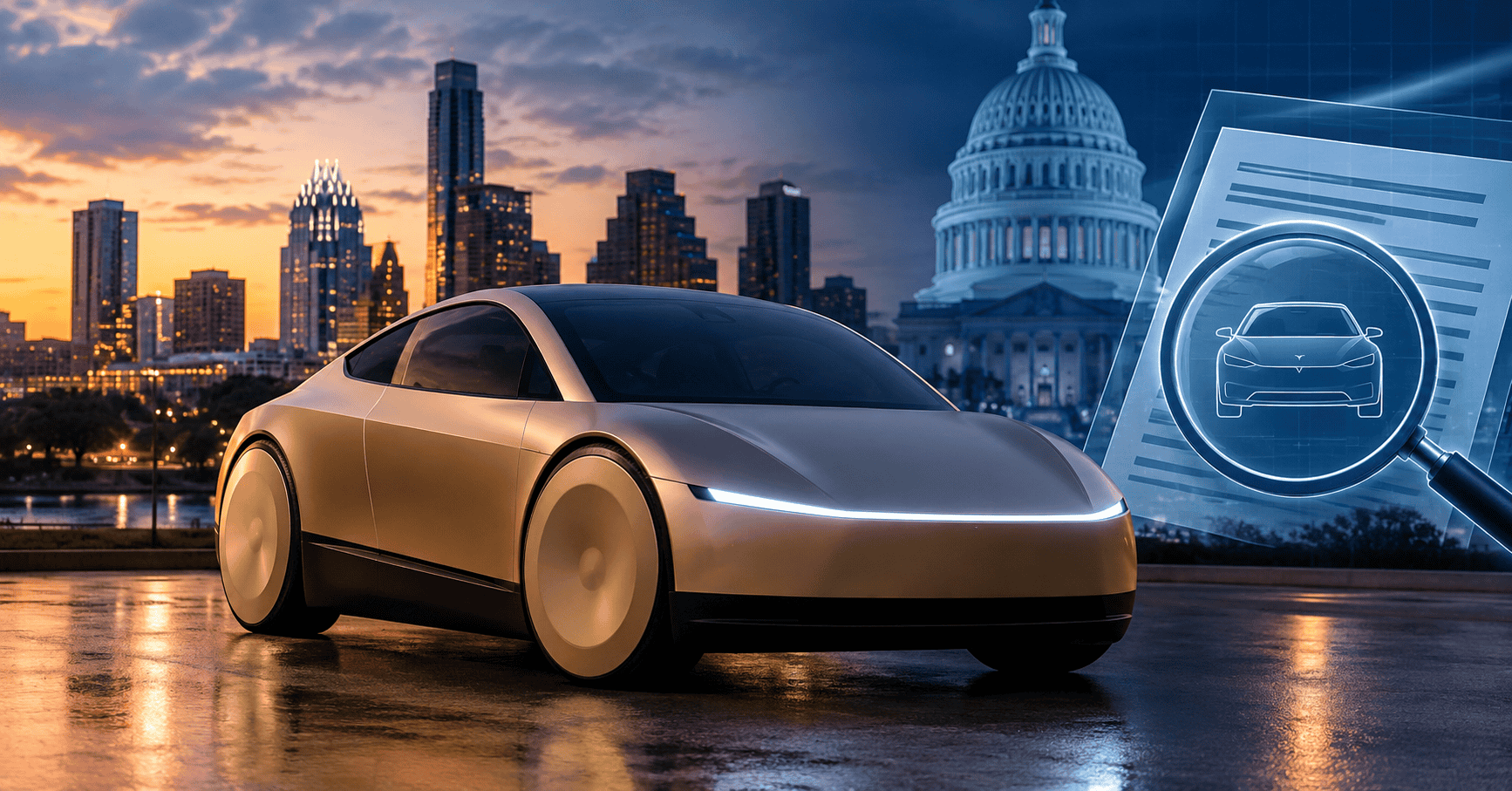
Tesla’s long-promised Cybercab is finally beginning to carry members of the public, but its much-anticipated debut is arriving with an unexpected complication: the vehicle is already facing scrutiny from US regulators.
The electric automaker is preparing to put its distinctive two-seat, fully autonomous vehicle into service in Austin, Texas. Unlike conventional cars, the Cybercab has no steering wheel or brake pedals, reflecting Tesla’s vision of a future in which passengers simply get in, select their destination, and let the vehicle handle the rest.
But as Tesla begins welcoming riders, the National Highway Traffic Safety Administration (NHTSA) is examining whether the Cybercab complies with federal vehicle safety requirements.
Federal regulators are taking a closer look
The NHTSA investigation, known as an Audit Query, focuses on how Tesla determined that the Cybercab meets existing federal safety standards.
That question is particularly important because the vehicle was designed without several controls and components normally found in passenger cars. Tesla has argued that it does not need a special federal exemption because its vehicles already comply with the rules currently on the books.
Regulators, however, appear to be taking a closer look at that position.
NHTSA is in the process of updating federal vehicle regulations to better accommodate autonomous vehicles. Among the standards being reconsidered are requirements involving equipment such as brake pedals, windshield wipers, and rearview mirrors—features that may not be necessary in vehicles designed to operate entirely without a human driver.
Until those changes take effect, however, existing federal requirements remain applicable.
Tesla is taking a different approach from Zoox
The issue has become more significant because other companies developing purpose-built autonomous vehicles have been required to seek exemptions before putting their unusual designs into passenger service.
Amazon-owned Zoox, for example, operates vehicles without steering wheels or conventional manual controls. The company recently became the first developer of a steering-wheel-free robotaxi to receive a federal exemption, although that approval limits its deployment to 2,500 vehicles during the year.
Tesla has taken a different position.
Rather than requesting an exemption, the company maintains that the Cybercab complies with current federal safety rules. The NHTSA Audit Query will now examine the information and reasoning behind that determination.
NHTSA Administrator Jonathan Morrison said the agency supports the development of autonomous vehicles but also has a responsibility to ensure manufacturers follow federal law.
A significant moment for Tesla’s robotaxi ambitions
The investigation comes at a particularly important time for Tesla.
The company has been positioning autonomous driving as a central part of its future, with CEO Elon Musk repeatedly arguing that Tesla should be viewed as more than a traditional car manufacturer. The Cybercab is perhaps the clearest physical representation of that strategy.
Tesla is gradually expanding its robotaxi operations in parts of Texas and Florida, and the company ultimately envisions deploying a vastly larger fleet.
For now, the Cybercab rollout remains relatively small. State records show that Tesla has around 45 of the vehicles in its Texas fleet, although the company has ambitions to produce and deploy millions of autonomous vehicles each year.
The investigation could have real consequences
An NHTSA investigation does not necessarily mean Tesla has violated federal law. However, the agency has several tools available if it determines that the Cybercab or Tesla’s compliance process falls short of federal requirements.
Regulators can require manufacturers to make changes to vehicles or procedures and can pursue enforcement actions that may include substantial financial penalties.
That makes the timing of the investigation significant. Tesla is launching a vehicle intended to represent the next chapter of its business at the same moment federal regulators are questioning the process used to clear that vehicle for the road.
For Tesla, the success of the Cybercab will depend on much more than whether passengers are willing to ride without a steering wheel or brake pedal. The company will also need to convince regulators that its vision of autonomous transportation can operate safely—and within the rules already governing American roads.