
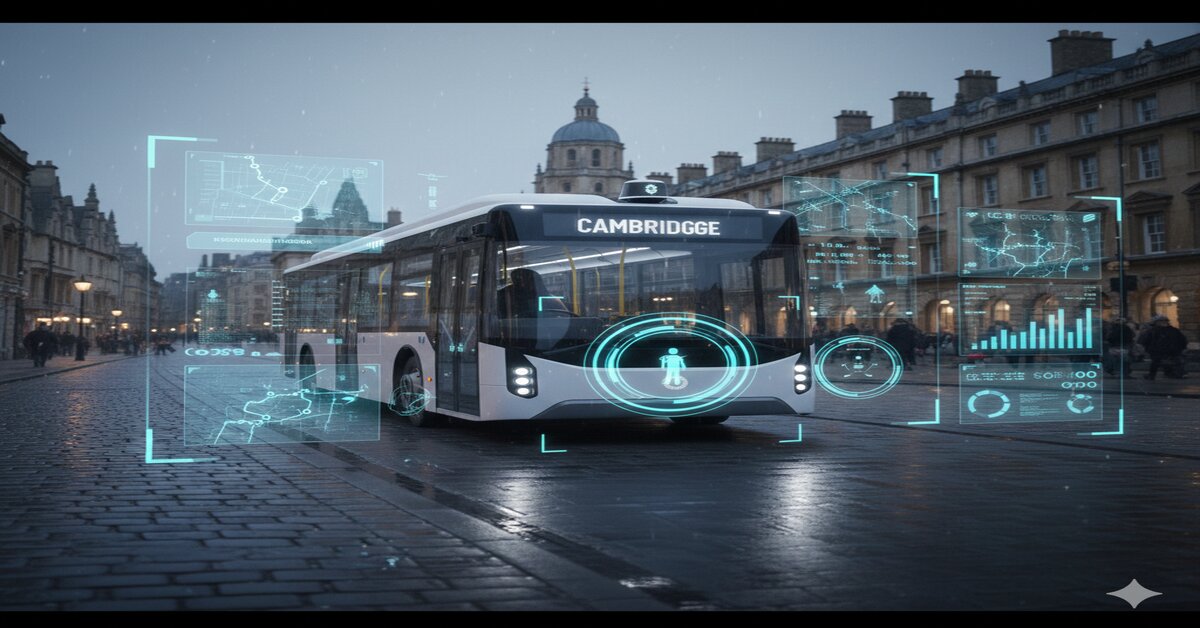
A new stage of Cambridge’s autonomous transport journey is now underway, as a 26-seat self-driving bus enters service as part of the Connector trial. Following months of detailed virtual simulations and real-world road testing, the vehicle officially began carrying passengers on Wednesday, December 17. A second large Connector bus is expected to join the trial in the coming weeks, expanding the scope of the project and giving more people the chance to experience autonomous public transport.
The free service connects Trumpington and Babraham Park & Ride sites with the Cambridge Biomedical Campus (CBC), one of the city’s busiest employment hubs. Operating Monday to Friday throughout the week, the buses are designed to offer a practical, everyday transport option rather than a limited demonstration. By running on regular routes and timetables, the project aims to show how autonomous buses could realistically fit into Cambridge’s wider transport network.
Connector is led by the Greater Cambridge Partnership (GCP) and forms part of its long-term effort to address congestion, sustainability and accessibility across the city. The trial explores whether self-driving buses could play a role in meeting future travel demands while reducing environmental impact and improving reliability.
Earlier this year, a smaller Connector vehicle began operating in West Cambridge. Since its launch in June, that bus has carried more than 800 passengers and covered over 2,000 miles. The introduction of the two larger vehicles marks a significant step forward, increasing passenger capacity and allowing the technology to be tested at a greater scale in live traffic conditions.
Dan Clarke, Head of Innovation and Technology at the Greater Cambridge Partnership, said the rapid progress of the trial highlights the potential of autonomous transport. He noted that Connector became Cambridge’s first timetabled self-driving bus service in June, and just six months later the project is expanding with larger vehicles. According to Clarke, the goal is not only to prove the technology works, but to explore how autonomous buses could provide a sustainable and dependable public transport solution for the city.
Passenger experience is a key focus of the trial. GCP is working with research partner Anthrometric to better understand how people perceive and interact with self-driving vehicles. Using immersive virtual reality and behavioral research methods, Anthrometric is studying levels of comfort, trust and confidence among passengers, helping to inform how autonomous transport could be introduced more widely in the future.
The Connector project is funded by the UK government through the CAM Pathfinder Programme, delivered by the Department for Business and Trade’s Connected and Automated Mobility team in collaboration with Innovate UK and Zenzic. This support reflects the government’s broader ambition to position the UK as a leader in autonomous vehicle innovation.
The buses themselves are UK-designed and built Enviro100AEV electric autonomous vehicles, recently named ‘Vehicle of the Year’ at the 2025 Self-Driving Industry Awards. Manufactured by Alexander Dennis and equipped with an SAE Level 4 automated driving system developed by Fusion Processing, the buses combine artificial intelligence, high-performance computing, radar, lidar and camera technology. Trained safety drivers remain on board at all times to ensure passenger safety.
The Connector trial is being delivered through a partnership involving the Greater Cambridge Partnership, Fusion Processing, Alexander Dennis, dRISK, Whippet and Anthrometric, bringing together expertise from across transport, technology and research sectors.