
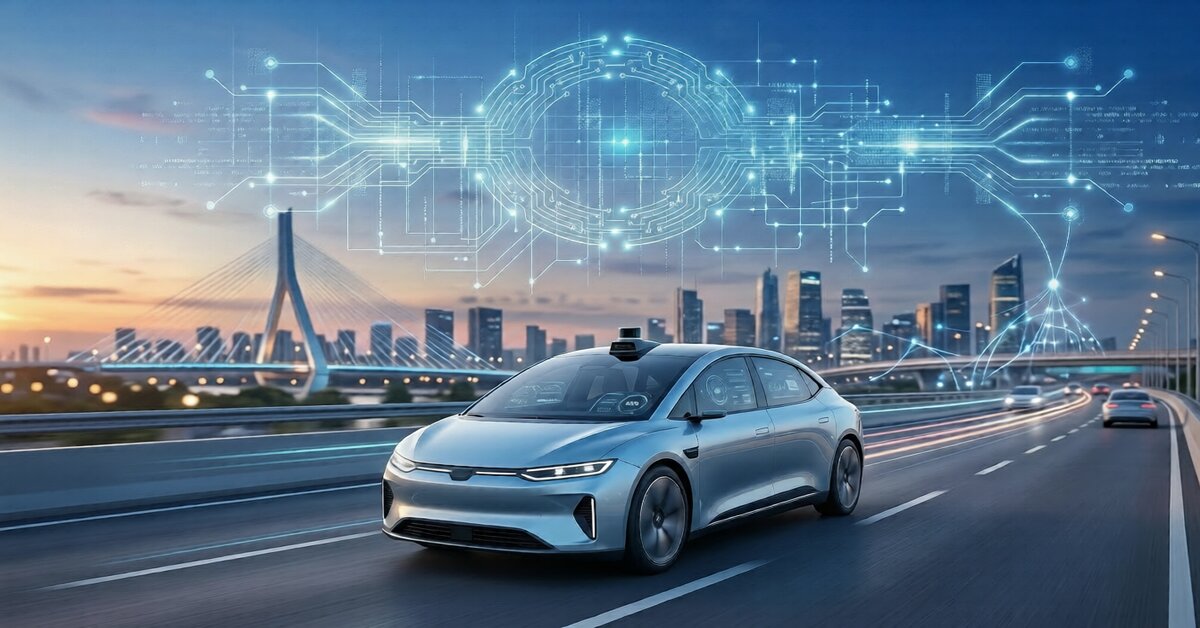
To accelerate the global rollout of Level 4 autonomous driving, Tensor has entered into a multiyear strategic collaboration with Arm Holdings to deliver the core compute architecture for its next-generation agentic AI personal robocar. The partnership is designed to provide the high-performance, safety-certified computing foundation required to commercialize advanced autonomy at scale across international markets.
At the center of the collaboration is Arm’s integrated compute platform, which combines hardware IP, software tooling, and a mature developer ecosystem. Tensor has built its vehicle architecture around this platform, deploying more than 400 Arm-based cores per robocar to enable distributed, safety-capable intelligence throughout the vehicle.
Unlike many automakers that retrofit autonomous features onto conventional vehicle platforms, Tensor is engineering its robocar with intelligence embedded from the ground up. The vehicle runs on a vertically integrated Level 4 autonomy stack supported by an extensive and carefully layered sensor array. This includes 37 cameras, five lidar units, 11 radars, 22 microphones, and 10 ultrasonic sensors, along with three inertial measurement units (IMUs), global navigation satellite system (GNSS) positioning, and multiple redundancy systems. Additional safeguards include 16 collision detectors, eight water-level sensors, four tire-pressure monitors, a smoke detector, and triple-channel 5G connectivity to ensure resilient communication.
Each robocar integrates 433 Arm-based cores tailored to specific functional domains. Arm Neoverse AE cores handle high-throughput AI processing, while Cortex-X processors manage in-cabin agentic AI and peak-performance system control. Cortex-A cores support drive-by-wire operations, lidar processing, redundancy functions, and general compute tasks. For time-sensitive safety systems, Cortex-R cores provide real-time responsiveness, and Cortex-M cores oversee low-power subsystems. Tensor’s proprietary autonomy stack also leverages Nvidia-accelerated processing to complement the Arm-based architecture, enabling complex AI workloads to operate seamlessly across heterogeneous compute environments.
Drew Henry, executive vice president of Arm’s Physical AI business unit, emphasized that autonomous vehicles represent one of the most tangible examples of AI moving into the physical world. He noted that such systems require high-performance, power-efficient, and safety-focused compute foundations, supported by robust software ecosystems and certification frameworks. According to Henry, Tensor’s robocar demonstrates how deep engineering discipline combined with scalable compute architecture can translate advanced AI innovation into real-world mobility solutions.
Dr. Jewel Li, chief operating officer at Tensor, highlighted that bringing personal autonomous vehicles to market requires more than cutting-edge AI algorithms. Achieving reliable, safe, and energy-efficient performance at scale demands rigorous systems engineering, redundancy planning, and long-term reliability strategies. She described the partnership with Arm as a critical enabler, combining decades of compute expertise with Tensor’s vertically integrated autonomy platform.
The Tensor robocar is scheduled for commercial availability in 2026, with initial launches planned in the United States, the European Union, and select Middle Eastern markets. Through its collaboration with Arm and a broader ecosystem of strategic partners, Tensor aims to transition advanced Level 4 autonomy from controlled pilot programs to widespread real-world deployment.