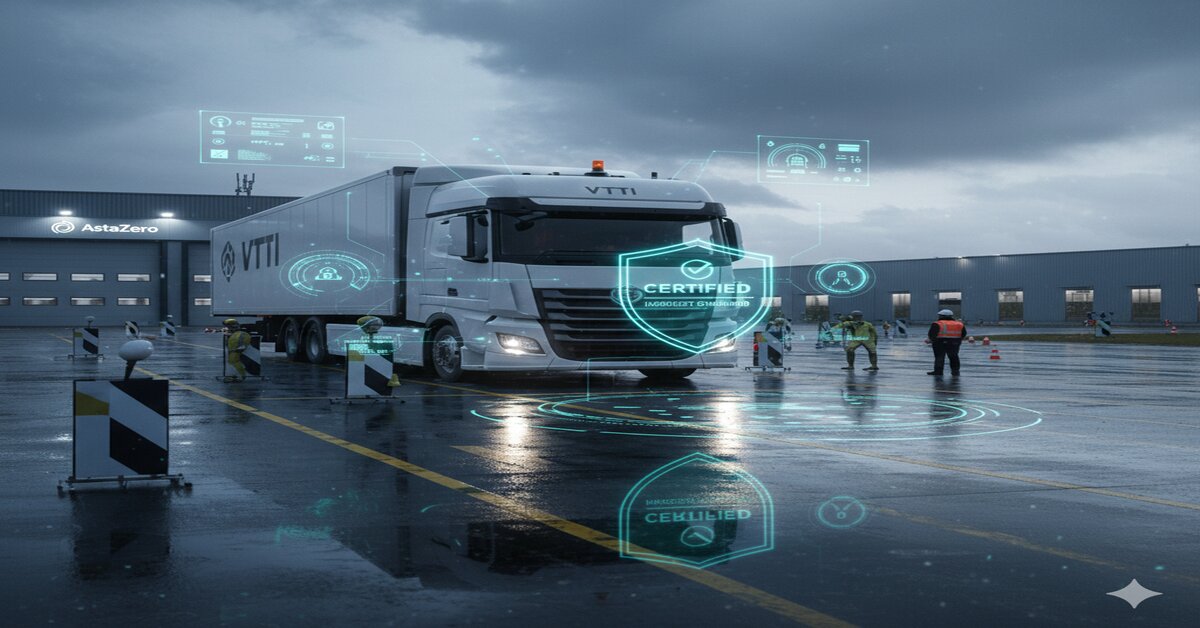
The safety validation of autonomous vehicles (AVs) is navigating a critical crossroads. Currently, the testing landscape is fragmented, often relying on proprietary, company-specific methods that make apples-to-apples comparisons nearly impossible. To solve this, the Virginia Tech Transportation Institute (VTTI) and Sweden’s AstaZero have forged an international partnership, successfully integrating their sophisticated testing systems to establish a new, universally applicable standard for AV safety evaluation.
This pioneering collaboration marks the first time AstaZero’s systems have been deployed and synchronized with a U.S. facility. The goal is straightforward yet profound: to create repeatable, scalable evaluation methods that foster greater public confidence in future mobility technology.
Integrating Global Expertise on the Smart Road
The project brought together VTTI, a leading U.S. transportation research institute, and AstaZero, a world-class proving ground owned by the RISE Research Institutes of Sweden. At the heart of the technical integration was the marriage of VTTI’s automated Ford F-150 pickup truck with AstaZero’s open-source Automated Vehicle Test Operating System (ATOS).
This synchronization provided an unprecedented level of control, allowing test targets and the vehicle under scrutiny to communicate and execute precise, choreographed movements. Mike Mollenhauer, VTTI’s division director of technology implementation, underscored the urgency of this endeavor, explaining that the ultimate objective is to develop efficient, effective testing procedures that move beyond custom solutions to establish an industry-wide uniform method.
The Breakthrough: Achieving Perfect Repeatability
The primary hurdle in current AV testing is the inherent inconsistency introduced by human intervention. To eliminate this “noise,” the VTTI and AstaZero teams engineered a specific, fully automated test scenario: the automated F-150 attempted a left turn through an intersection while AstaZero’s automated carrier platform maneuvered a pedestrian dummy directly into the truck’s path.
Because the entire event was automated—from the truck’s motion to the dummy’s speed and position—the researchers could rerun the scenario multiple times with exact precision. In every iteration, the truck’s safety system successfully detected the dummy and executed a timely, complete stop. This ability to replicate complex, high-stakes events precisely is absolutely critical for verifying a vehicle’s safety systems under a vast range of variable conditions, all without the confounding factor of human error.
Utilizing Unique Environmental Conditions
The testing was conducted on VTTI’s renowned Smart Road in Blacksburg, Virginia. Timo Kero, AstaZero’s chief technology officer, highlighted a major strategic advantage of the partnership: the Smart Road’s unique ability to generate controlled weather conditions, including rain and fog. While AstaZero operates an excellent dry track in Sweden, VTTI’s facility offers the diverse, real-world environmental challenges that are essential for robust and comprehensive safety validation.
VTTI contributed its deep experience in autonomous technology, recently demonstrated by its completion of a concept of operations for autonomous trucking. AstaZero, conversely, enriched the collaboration with its expertise in the wider connected vehicle ecosystem, including critical areas like cybersecurity and artificial intelligence.
Paving the Way for Safer Roads
The successful technical integration achieved by VTTI and AstaZero represents a crucial foundation for future, more intricate testing scenarios. Both organizations are committed to continuing their partnership to refine and expand these groundbreaking methods. By sharing their assets and deep expertise, VTTI and AstaZero aim to raise the bar for safety testing across the entire industry.
As Mollenhauer concluded, this work ensures a “repeatable process for testing current systems, new systems that are developed, and more complex scenarios as this technology grows.” This forward-thinking approach is not just about testing today’s AVs; it’s about actively securing the safety of automated vehicles as they evolve to navigate the inherently unpredictable challenges of our real-world roads.