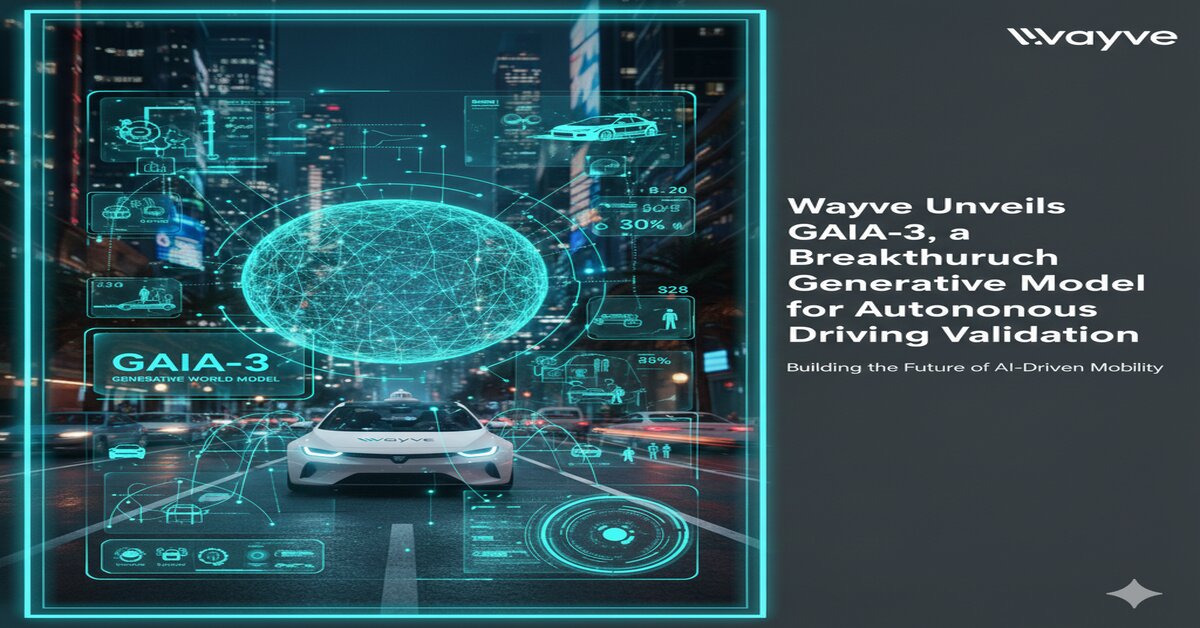
Wayve has introduced GAIA-3, the newest evolution of its generative world model and a significant leap forward in how autonomous driving systems can be evaluated and validated. Positioned as a major upgrade to the already influential GAIA-2, the latest model is engineered to provide richer, more accurate simulations aimed at accelerating the development of end-to-end AI driving systems. According to the company, GAIA-3 is larger, more capable and purpose-built to tackle the limitations of current testing methods.
One of the biggest challenges in autonomous vehicle development is that real-world safety-critical events—such as near-misses, unpredictable road users or rare hazardous scenarios—happen infrequently and are often too dangerous to recreate deliberately. Traditional validation therefore relies heavily on controlled test-track trials, which cannot fully replicate the diversity, unpredictability or complexity of everyday driving. Generative world models offer a promising solution by creating realistic, dynamic simulations that expose AI driving systems to a wide variety of situations without putting anyone at risk. These synthetic environments allow models to safely learn, reason and make decisions as if they were operating on real streets.
GAIA-3 represents a substantial technical leap. The model contains 15 billion parameters—twice as many as GAIA-2—and incorporates a next-generation video tokenizer that is also doubled in size. These enhancements allow GAIA-3 to represent physical interactions, environmental cues and causal relationships with far greater fidelity. Wayve notes that the model has been trained on ten times more data than its predecessor, drawing from a broader range of geographies, vehicle platforms, weather conditions and road types. As a result, the generated video sequences exhibit sharper imagery, more stable lighting and improved texture details. Road signs, lane markings and surface variations are rendered with noticeably higher precision.
Beyond improved visual realism, GAIA-3 introduces several new evaluation modes designed to expand the usefulness of generative world models in autonomy development. A key addition is safety-critical scenario generation, which enables controlled testing of rare edge cases that cannot be recreated in real traffic. Another feature, called embodiment transfer, allows the model to assess driving performance consistently across different vehicle hardware setups. GAIA-3 also supports controlled visual diversity, enabling researchers to stress-test AI systems under varied lighting, weather and environmental conditions to ensure robustness.
Importantly, Wayve emphasizes that GAIA-3 moves world modeling beyond simple visual content creation and into the domain of full autonomy evaluation. The model can generate structured, coherent driving scenes suitable for quantitative performance analysis, allowing comparisons of how different AI driving systems behave under identical conditions. Early internal studies suggest that simulations produced by GAIA-3 strongly correlate with real-world results and have helped reduce the rejection rate of synthetic test data by a factor of five.
Jamie Shotton, chief scientist at Wayve, described GAIA-3 as a major step forward. “The model learns to recreate the dynamics of real-world environments—from everyday traffic flows to extremely rare safety events,” he said. “With GAIA-3, developers can finally measure and accelerate progress toward safer and more scalable autonomous driving.”
Wayve is also collaborating with Warwick Manufacturing Group at the University of Warwick through DriveSafeSim, a government-funded UK initiative aimed at rigorously validating generative world models like GAIA-3 for use in safety assessment. Together, these efforts highlight the growing role of high-fidelity simulation in building reliable, future-proof autonomous driving systems.