
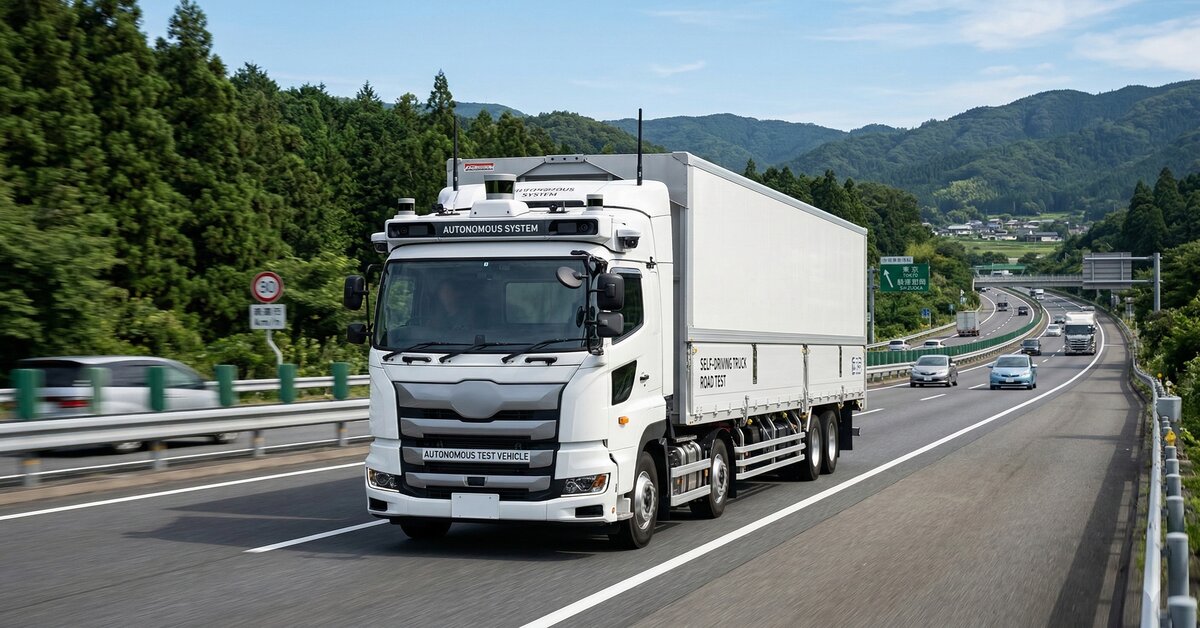
Toyota Tsusho has begun public road demonstration trials of autonomous semi-trailer trucks on major expressways in central Japan, marking another step toward introducing self-driving freight transport into regular logistics operations. The tests are taking place between logistics hubs in the Japanese prefectures of Shizuoka Prefecture and Aichi Prefecture, with trial runs scheduled to continue until 12 March 2026.
The demonstration program involves a single autonomous semi-trailer operating along sections of the Shin‑Tomei Expressway and Tomei Expressway. During the trial period, the vehicle will run using Level 2 autonomous driving technology, meaning the truck can assist with steering and acceleration while still requiring human supervision. Engineers and safety operators will closely monitor its performance throughout the tests to ensure safe operation on public roads.
These trials form part of a broader government-supported initiative led by Japan’s Ministry of Land, Infrastructure, Transport and Tourism aimed at accelerating the real-world adoption of autonomous long-haul trucking. The project focuses on evaluating how automated vehicles could be integrated into trunk line freight routes that connect major logistics centers across the country.
To carry out the project, a consortium headed by Toyota Tsusho was selected by the ministry. The group brings together several logistics and technology partners, including Robotruck, Otsuka Warehouse, Seino Transportation, and Fukuyama Transporting. Each partner contributes specific expertise, ranging from autonomous driving technology and fleet management to large-scale freight operations.
A key focus of the demonstration is evaluating the safety and operational performance of the autonomous semi-trailer developed by Robotruck. Researchers will analyze how the vehicle behaves under real traffic conditions, while also measuring its potential value for everyday freight transportation. The team will also examine whether the technology could deliver economic benefits for logistics companies.
Toyota Tsusho believes that semi-trailers equipped with autonomous technology could help improve efficiency in the freight sector. Compared with conventional trucks, semi-trailers generally offer larger cargo capacity, which can reduce the number of trips required to transport goods. In addition, the company notes that trailer-based logistics systems can allow tractors to detach and move on to other assignments instead of waiting during loading and unloading operations, potentially increasing overall productivity.
The company is not new to autonomous truck research. In previous years, Toyota Tsusho participated in a separate project supported by the Ministry of Economy, Trade and Industry, where it conducted long-term demonstration tests of self-driving trucks. According to the company, those earlier trials provided encouraging results, particularly in terms of vehicle safety and the technical feasibility of autonomous driving systems.
However, Toyota Tsusho emphasizes that moving from testing to large-scale deployment requires more than just technological readiness. The company says it must also evaluate how autonomous trucks would affect logistics business models, operational structures, and profitability across the supply chain.
Insights gathered during the current road demonstrations will therefore play a crucial role in shaping the next phase of development. Based on the technical data and economic assessments from the project, Toyota Tsusho plans to continue refining its strategy with the goal of bringing autonomous trucking closer to practical use in Japan’s freight transport industry.