
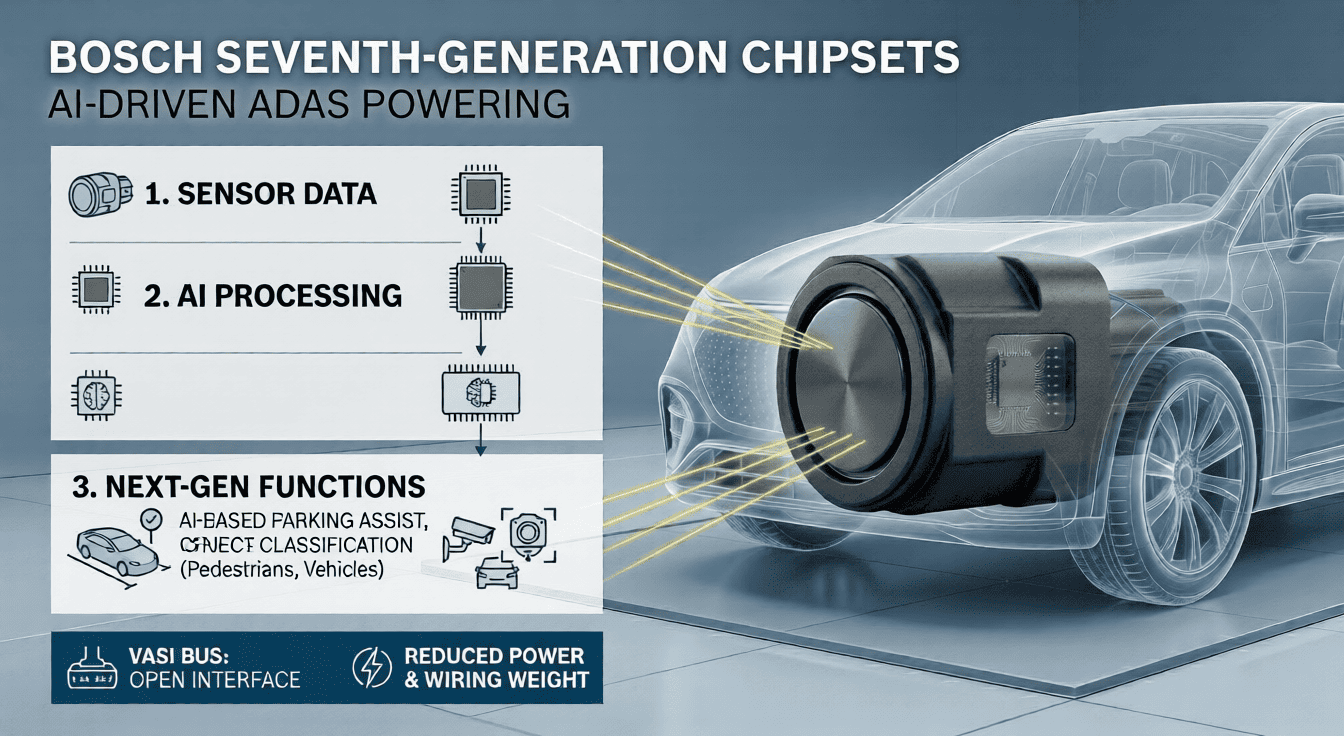
Bosch has revealed its latest seventh-generation ultrasonic chipsets—TB193 and TB293—aimed at advancing AI-driven parking and driver assistance technologies. Announced during Auto China in Beijing and detailed on April 24, 2026, the new chips mark a shift toward capturing raw sensor data directly at the source, enabling more precise perception for modern vehicles.
Moving Toward Raw Data Processing
Unlike earlier systems that relied on pre-processed signals, Bosch’s new approach focuses on preserving original sensor data. The TB293 chip is mounted directly at the ultrasonic transducer, where it records unfiltered signals without intermediate modification. These signals are then coordinated by the TB193 controller, which aggregates data from multiple sensors before sending it to the vehicle’s central processing unit.
This architecture allows AI-based systems to work with richer and more detailed information. As a result, parking assistance technologies can better interpret complex environments—such as tight garages, crowded parking spaces, or areas with obstacles like pillars and walls. Additionally, the system shows potential for identifying surface conditions, including wet or uneven roads, which could contribute to more context-aware driving responses.
Supporting Software-Defined Vehicles
The dual-chip setup reflects the broader industry transition toward centralized and software-defined vehicle platforms. By separating sensing and control functions, Bosch aims to simplify wiring, reduce system complexity, and enable scalability across different vehicle segments. This modular approach makes it easier for automakers to adjust sensor configurations depending on vehicle requirements.
Introducing an Open Sensor Interface
A notable shift in Bosch’s strategy is the introduction of the VASI (Vehicle Access Sensor Interface) bus—an open interface that transmits both power and data through a single line. For the first time, Bosch is also offering its ultrasonic integrated circuits as standalone components, rather than bundling them exclusively within complete sensor systems.
This move gives automakers greater flexibility in selecting sensor suppliers, signaling a departure from Bosch’s traditional turnkey model. It also aligns with the company’s broader push to supply its automotive semiconductor technologies—including radar and ADAS computing solutions—to external partners.
Performance and Efficiency Gains
From a technical standpoint, the chipsets support a data rate of 1.16 Mbps, enabling real-time transmission of raw ultrasonic signals without data loss. This bandwidth is essential for integrating ultrasonic data with inputs from cameras and radar systems, supporting advanced sensor fusion and AI-driven decision-making.
Bosch also emphasizes improvements in efficiency. The new chips reportedly reduce power consumption by up to 50% compared to similar solutions, while also lowering the number of required external components and pins. The VASI interface further contributes by reducing cabling weight by as much as half. Additionally, the chipsets are designed to operate in high-temperature environments, withstanding up to 150°C, making them suitable for installation near engine compartments.
Building Toward Higher Automation
Bosch positions these chipsets as a foundation for future vehicle automation. While they enhance current parking and assistance features, the same architecture is designed to scale toward more advanced autonomous driving capabilities over time.
The announcement complements Bosch’s ongoing developments in Level 3 automated driving, reinforcing its commitment to expanding its presence in the evolving ADAS market—particularly in regions like China, where demand for advanced driver assistance technologies continues to grow.